

Hiring security is one of the most important decisions a property manager, business owner, or HOA board can make. It can also be confusing. “Security guard” covers many different jobs. A guard at a hotel lobby, a patrol officer checking a construction site at 2 a.m., and a fire watch guard at a warehouse all do very different work.
At Griffin Protection Services, we have provided security guards across San Jose, Santa Clara, and the greater Bay Area since 2005. This guide covers the main types of security guards, what each one does day to day, and how to choose the right coverage for your property.
Every type of security guard exists to protect people, property, and assets. Most do this through four core functions:
The differences between guard types come from where they work, how they work, and what risks they are trained to manage.
Contract guards are employed by a licensed security company and assigned to a client’s site. The company handles hiring, background checks, training, scheduling, supervision, insurance, and replacement coverage. Most businesses choose this model because it is flexible and avoids the cost of building an in-house security department.
In-house guards are hired directly by the organization they protect. This model gives the organization direct control, but it also means taking on recruiting, training, licensing compliance, and liability.
Unarmed guards make up most of the private security workforce. They rely on presence, communication, observation, and de-escalation rather than weapons. For most offices, apartment communities, hotels, retail centers, schools, and construction sites, a well-trained unarmed guard is the right fit. They are approachable, lower-risk, and usually more cost-effective. Griffin Protect specializes in professional unarmed security with a strong focus on de-escalation.
Armed guards carry firearms and need additional state licensing, training, and screening. They are generally reserved for high-risk environments, such as cash handling or sites with a documented history of violent threats. Having an armed guard also raises liability, so the choice should come out of a proper risk assessment.
A static guard is posted at a fixed location, such as a front desk, lobby, gate, or loading dock. Duties include monitoring entry points, checking IDs, signing in visitors, watching cameras, and acting as the first point of contact.
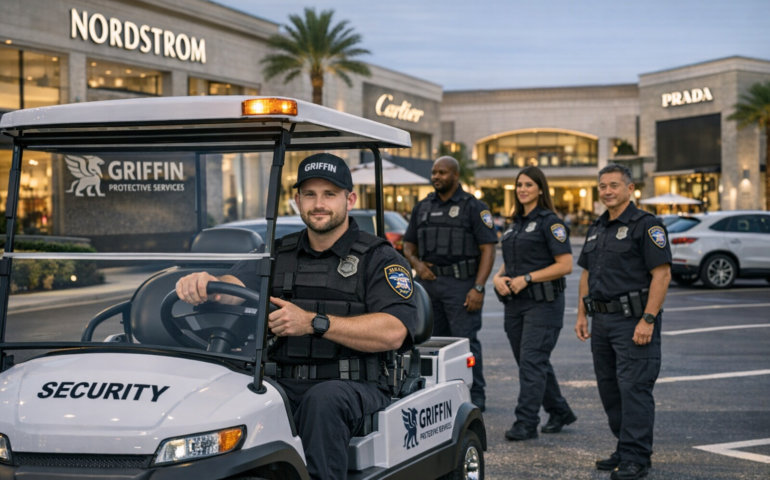
Mobile patrol officers cover one or more properties by vehicle or on foot, on scheduled or randomized routes. Patrols work well for large campuses, business parks, parking structures, and apartment communities that need a visible presence without a full-time guard on every post.
When a fire alarm or sprinkler system is offline, local fire authorities often require a dedicated fire watch. These guards patrol the building, look for fire hazards, keep logs, and alert emergency services right away if something happens.
Construction security guards protect equipment, materials, and jobsites from theft, vandalism, and trespassing, especially after hours and on weekends.
Hotel security officers balance protection with guest service. They manage access, respond to disturbances, patrol common areas, and handle incidents without disrupting the guest experience.
Retail guards deter shoplifting, support store staff, and keep shopping centers safe and welcoming for customers and tenants.
Residential and HOA guards enforce community rules, handle parking complaints, monitor amenities, and give residents a visible sense of safety.
School security officers protect students, faculty, and staff. They are trained to keep an open, supportive environment while controlling access and responding to emergencies.
Healthcare security officers handle high-stress situations in emergency departments, protect staff and patients, and support safe, controlled medical environments.
Event guards manage entry points, crowd flow, and incident response at corporate events, private celebrations, and community gatherings.
Also called bodyguards, these specialists protect specific individuals rather than properties. Executive protection requires advanced training and, in some states, separate licensing.
Modern security often pairs guards with technology. Mobile surveillance trailers and drone monitoring extend coverage across large open sites where static guards alone would not be enough.
Identify what you are protecting and what you are protecting it from. A construction site worried about copper theft needs different coverage than a hotel dealing with unwanted loiterers. A good security company will walk your site before quoting.
Constant foot traffic and a single main entry usually call for a static guard. Large or multiple properties often get better value from patrol. Many sites benefit from both.
Don’t default to armed security. For most commercial and residential properties, trained unarmed guards who focus on de-escalation provide strong protection with less liability.
In California, security companies must hold a Private Patrol Operator (PPO) license, and every guard must hold a BSIS guard card. You can verify both on the California Department of Consumer Affairs license lookup. Griffin Protection Services operates under PPO #121613.
Ask how guards are trained in de-escalation, report writing, and emergency response. Also ask how often supervisors visit sites.
You should get clear incident reports and have a responsive management team you can reach 24/7.
Look for years in business, local references, and verified reviews from clients in your industry.
Griffin Protection Services is a locally owned security company based in Santa Clara that has served San Jose and the surrounding region for more than 20 years. Our BSIS-compliant officers are background-screened, trained in de-escalation and access control, and supported by supervisors and patrol vehicles. We build each security plan around your property’s specific risks, whether you need short-term coverage or a long-term partnership.
What is the most common type of security guard?
The unarmed static guard is the most common. These guards are posted at a fixed location such as a lobby, gate, or front desk.
What is the difference between a security guard and a patrol officer?
A static guard stays at one post. A patrol officer moves between areas or properties on a set or randomized route.
Do I need an armed or unarmed security guard?
Most businesses and residential communities are well served by trained unarmed guards. Armed security should be based on a documented high-risk assessment.
How do I know if a security company is licensed in California?
Search the company’s PPO license number and the guard’s registration on the California Department of Consumer Affairs license lookup.
Need help choosing the right security coverage? Contact Griffin Protect or call 408-330-6003 for a free security assessment.