



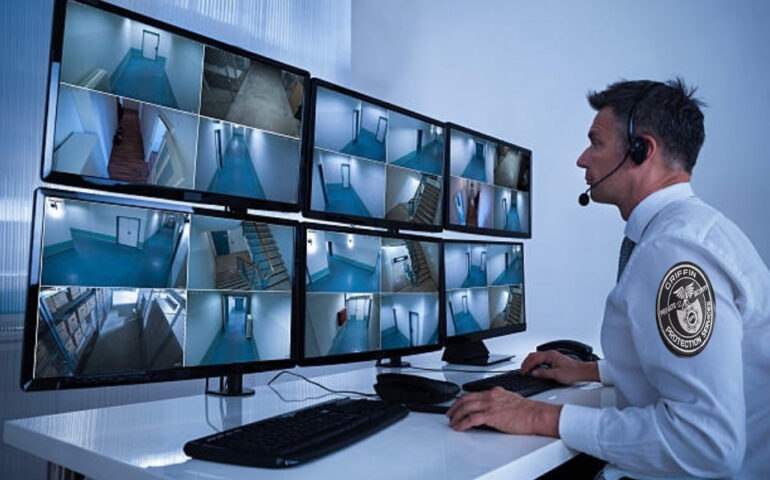
Most businesses don’t need to choose but if you had to, security guards generally provide stronger active deterrence and real-time response, while cameras offer continuous, lower-cost coverage and recorded evidence.
The businesses that see the best security outcomes typically combine both, using cameras to extend visibility and guards to act on what those cameras see.
If you’re deciding how to protect your property, employees, or customers, here’s how the two options actually compare and how to figure out which mix makes sense for your business.
The simplest way to think about the distinction: cameras provide awareness, while guards provide action.
A surveillance camera records and, in some setups, actively monitors activity but on its own, it can’t intervene. It can’t stop a shoplifter mid-theft, de-escalate a conflict, check a suspicious vehicle in the parking lot, or physically escort a trespasser off the property. Guards can do all of that in real time.
This distinction matters more than people often expect. Research on camera effectiveness has found that passive, record-only camera systems show little to no measurable effect on crime rates, while actively monitored systems where someone is watching the feed and can respond are associated with meaningful reductions. In other words, a camera’s value depends heavily on what happens after it sees something.
A randomized controlled trial conducted at a mass transit system found that increasing the presence of security guards led to a measurable drop in victim-generated crimes at the stations studied, along with a notable rise in crime detections. The researchers described private security personnel as active, human-driven agents of deterrence fundamentally different from a fixed camera, since guards can conduct unpredictable patrols, notice contextual details a camera would miss, and adapt in real time to what they observe.
Cameras, meanwhile, tend to perform especially well in specific, narrower use cases deterring vehicle break-ins in parking structures, for example, or providing recorded evidence after an incident. Multiple studies point to significant reductions in vehicle-related crime in camera-covered parking areas, even when overall crime reduction elsewhere is more modest.
The consistent theme across the research: cameras and guards aren’t really competing solutions they address different parts of the same problem.
| Factor | Security Guards | Surveillance Cameras |
|---|---|---|
| Deterrence | Strong – visible, unpredictable human presence | Moderate – depends heavily on visibility and active monitoring |
| Real-time response | Yes – can intervene, de-escalate, or evacuate | No – cameras alone cannot act |
| Coverage | Limited to patrol routes and staffed hours | Continuous, can cover multiple angles 24/7 |
| Evidence collection | Verbal reports, incident documentation | Recorded video evidence |
| Cost structure | Higher ongoing labor cost | Lower recurring cost after installation |
| Adaptability | High – can respond to unexpected situations | Low – limited to what’s within camera view |
| Customer/employee experience | Can provide a welcoming, reassuring presence | Passive, no direct interaction |
| Best suited for | Active risk environments, access control, high-traffic areas | Fixed-location monitoring, evidence backup, budget-conscious coverage |
Guards tend to be the stronger choice when your business needs:
Cameras are often the more practical choice when:
Security guards and surveillance cameras address different weaknesses in each other’s coverage. Cameras extend visibility into areas a guard can’t watch continuously, and guards provide the response capability a camera can’t offer on its own. A few ways this combination plays out in practice:
For many businesses, mobile surveillance units deployable cameras or camera-equipped trailers offer a middle-ground option, especially for temporary needs like construction sites or vacant properties where permanent camera installation isn’t practical.
If you’re still weighing the options, these questions can help clarify the right fit for your property:
There’s no universal answer to guards versus cameras the right approach depends on your property, your risk profile, and your budget. Griffin Protect works with businesses across San Jose, Santa Clara, and the greater Bay Area including tech campuses, hospitals, hotels, schools, and retail centers to design security coverage that fits the specific risks each property faces, whether that means on-site guards, mobile patrols, camera-based monitoring, or a combined approach.
Contact Griffin Protect today for a security risk assessment, and we’ll help you build a plan that actually matches your property’s needs.
Are security guards more effective than cameras at preventing crime? Research suggests guards generally provide stronger active deterrence, since they can respond in real time and patrol unpredictably, while cameras are most effective at deterring crime when actively monitored rather than simply recording.
Are cameras cheaper than hiring security guards?
Generally, yes camera systems typically involve a larger upfront cost but lower ongoing expense, while staffing guards involves higher continuous labor costs, especially for 24/7 coverage.
Can I use cameras instead of guards to save money? It depends on your risk level. Cameras alone are often sufficient for lower-risk, fixed-location monitoring, but higher-traffic or higher-risk properties typically benefit from the real-time response only a guard can provide.
What’s the best security setup for a small business?
Many small businesses find a hybrid approach works best targeted camera coverage for continuous monitoring and evidence, combined with periodic guard patrols or on-site presence during higher-risk hours.
Do businesses really need both guards and cameras?
Not always, but combining the two typically produces better outcomes than either alone, since cameras extend visibility and guards provide the response capability cameras can’t offer.