



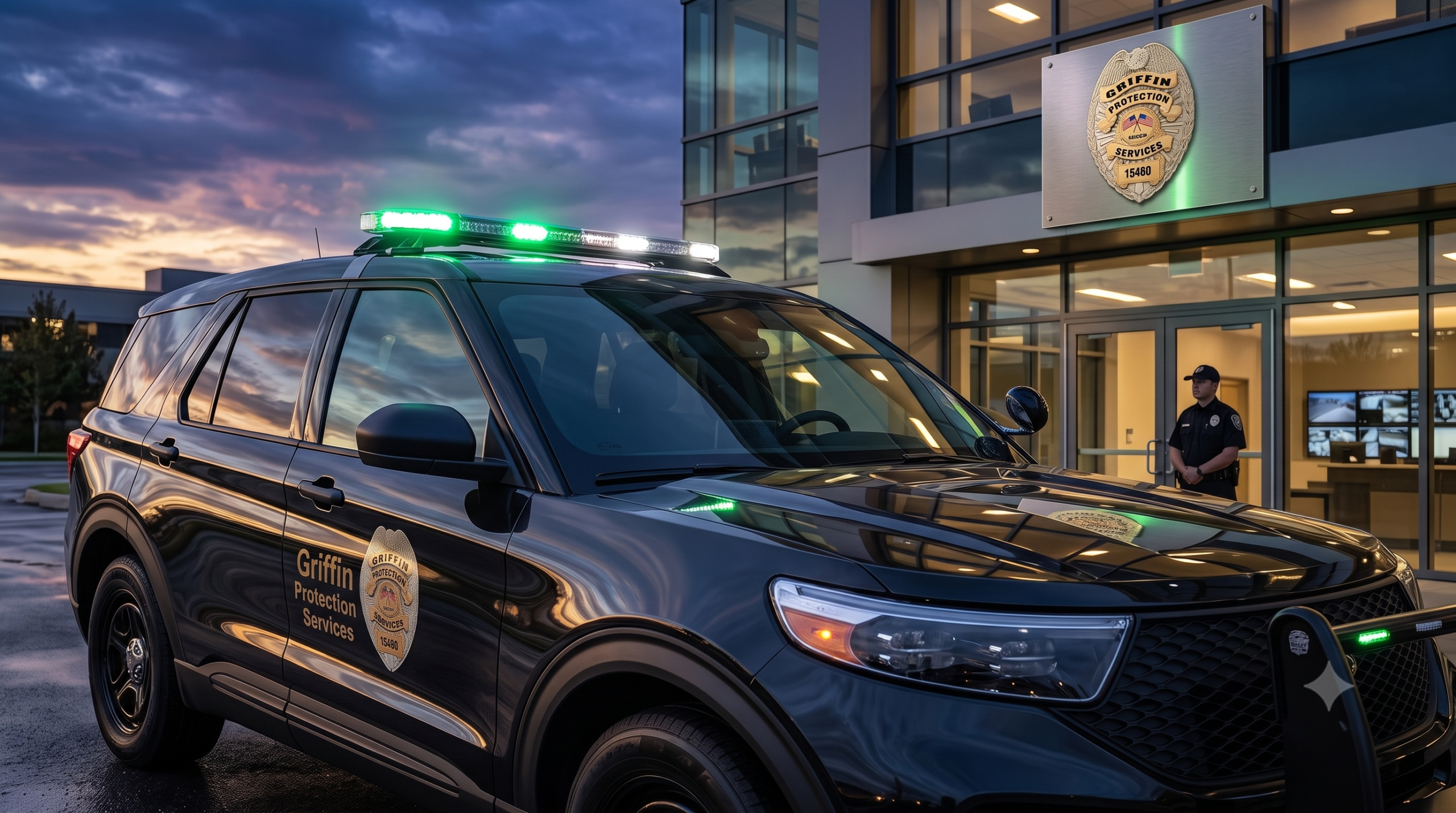
A petrol security guard is a trained security officer who monitors one or more properties by driving a marked patrol vehicle on a scheduled or randomized route, rather than staying fixed at a single post. Instead of standing at one entrance all shift, the guard checks doors, gates, parking areas, and common spaces at intervals, creating a visible and unpredictable security presence that deters theft, vandalism, and trespassing.
This model — often called a security petrol service — is built around mobility. One patrol officer can realistically cover several buildings or a large campus in the time it would take to staff each location with a dedicated guard, which is why it’s become a go-to option for commercial properties that need coverage without the cost of round-the-clock static staffing. Providers offering security patrol services in the Bay Area build these routes around each client’s specific layout and risk points.
Petrol security guard services use marked patrol vehicles and trained officers to check multiple locations on a set or randomized schedule throughout a shift. This provides visible, unpredictable coverage across parking lots, entrances, and perimeters, typically at a lower cost per hour than stationing a dedicated guard at each site.
Most security petrol providers follow a similar operational structure, even though the specifics vary by company and contract.
This is where mobile petrol security distinguishes itself from a guard who simply sits in a booth: the checkpoint data creates an audit trail that property managers and risk teams can review after the fact.
Commercial property managers, IT campuses, and hospitality groups generally choose a petrol security guard model for four reasons.
For a multi-building tech campus or a hotel with a large parking footprint, this combination of lower cost and wider coverage is often the deciding factor. Businesses in Santa Clara looking for this exact setup can review security patrol services in Santa Clara for a sense of how routes are typically structured around office parks and mixed-use properties.
| Factor | Petrol Security Guard | Static (Stationed) Guard | Remote Video Monitoring |
|---|---|---|---|
| Coverage area | Multiple sites/large campuses | Single fixed post | Wherever cameras are installed |
| Visible deterrence | High (vehicle presence, unpredictable) | High (constant presence) | Low (no physical presence) |
| Cost per site | Lower | Higher | Lowest (no on-site labor) |
| Physical intervention | Yes, on arrival | Yes, immediate | No (alerts only) |
| Best for | Multi-site commercial, campuses, hotels | High-traffic single entrances, lobbies | Budget-limited or camera-only sites |
| Response to active incidents | Fast, but not instant | Instant | Delayed (requires dispatch) |
Many organizations don’t pick one model exclusively — they layer a petrol security guard route with a stationed lobby guard during business hours and remote cameras overnight. This blended approach is common among companies offering both security patrol and guard services under a single contract.
Security and petrol coverage is a practical fit for organizations with property that’s too large, too spread out, or too intermittently active to justify a full-time stationed guard at every entrance.
If your property has areas a single stationed guard physically can’t monitor, a patrol-based model closes that gap. This is especially true for San Jose’s dense mix of tech campuses and commercial corridors, where security patrol services in San Jose are commonly built around multi-building routes.
Pros
Cons
Pricing for mobile petrol security in the U.S. typically depends on patrol frequency, number of checkpoints, shift length, and whether officers are armed or unarmed. As a general guide:
Unarmed patrol services generally cost less than armed coverage, and rates rise with faster response-time guarantees, holiday/weekend surcharges, and additional reporting requirements. Always ask a provider for a written rate breakdown by shift type before signing a contract — the range on any given site can swing significantly based on route complexity alone.
Not all security petrol companies operate at the same standard. Vet providers against this checklist before signing a contract.
What is the difference between a petrol security guard and a static security guard?
A petrol security guard patrols multiple checkpoints across one or more properties in a vehicle, while a static guard remains at a single fixed post for the entire shift.
Is petrol security guard coverage enough for a large office campus?
It can be, especially combined with access control and cameras, but many large campuses layer patrols with a stationed guard at the main entrance for a complete security posture.
How often do patrol officers check a property?
This depends on the contract — common options range from hourly drive-throughs to several randomized checks per shift, with frequency typically higher overnight.
Are petrol security guards armed or unarmed?
Both options exist. Most commercial and hospitality contracts use unarmed officers trained in de-escalation, while armed patrols are available for higher-risk sites at additional cost.
Can hotels use petrol security for parking structures?
Yes — parking garages, loading docks, and pool areas are among the most common checkpoints hotels add to a patrol route, since these areas fall outside the front desk’s sightline.
How do I verify a patrol officer actually visited my property?
Reputable providers use GPS-tracked checkpoints or scannable tags at each stop, generating a timestamped log you can review after every shift.
What happens if a patrol officer finds an intrusion or damage? The officer documents the incident, contacts the client and/or local authorities per the agreed protocol, and escalates according to the response plan set during onboarding.
Is a security petrol service cheaper than hiring full-time guards? Generally yes, per site, because one patrol unit can service multiple properties instead of one guard being dedicated to a single location full time.
Do security petrol companies offer both day and night patrols?
Most do, though night patrols are more common since visibility and foot traffic are lower, making randomized routes more valuable after hours.
Can I combine petrol security with camera monitoring?
Yes — a layered approach, where cameras provide continuous coverage and patrol officers provide physical verification and intervention, is one of the most common setups for commercial properties.
A petrol security guard program gives multi-site commercial properties, tech campuses, hotels, and organizations with sprawling grounds a way to extend real security coverage without paying for a stationed guard at every corner. The model works because it pairs physical presence with unpredictability, and because modern security petrol providers back it up with GPS-verified reporting that turns “someone drove by” into documented, auditable proof of coverage.
The providers worth hiring are the ones that treat your route like a custom security plan, not a template — with clear licensing, trained officers, and response-time commitments in writing. If your property needs coverage across multiple buildings, a parking structure, or grounds too large for one stationed guard, request a site walk from a licensed security petrol provider and ask for a written route proposal before you commit.
Ready to Secure Your Property?
Don’t wait for an incident to expose the gaps in your coverage. Whether you manage a tech campus, a hotel, or a multi-tenant commercial property, a customized patrol route can close the blind spots a single stationed guard can’t reach.
Get a free site assessment and a no-obligation patrol proposal built around your property today. Contact Griffin Protection to schedule your walkthrough and see exactly how a mobile patrol plan would cover your site.