



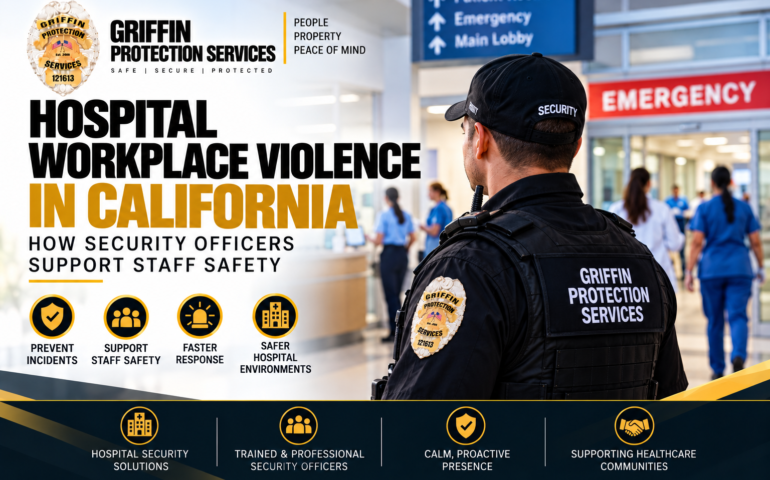
Security officers support hospital staff safety by preventing incidents before they start, responding quickly when a situation escalates, and documenting what happened so the hospital can improve. In California, hospitals are also required to keep a written workplace violence prevention plan, and trained security officers are a practical part of carrying it out.
Healthcare workers face a higher risk of workplace violence than people in most other jobs. Nurses, emergency department staff and behavioral health teams deal with patients and visitors who may be in pain, afraid, intoxicated or confused. This guide explains what California requires and how security officers fit into a hospital’s safety program.
Workplace violence is any act or threat of physical force against an employee that causes, or is likely to cause, injury or psychological trauma. In hospitals it commonly includes:
Many incidents go unreported because staff see them as part of the job. A strong program makes reporting simple and treats every report seriously.
California has some of the most detailed healthcare violence prevention rules in the country. The Cal/OSHA standard on violence prevention in health care, found in Title 8, section 3342, applies to hospitals and many other health facilities.
In general terms, covered employers must:
California has also passed legislation directing Cal/OSHA to add weapons detection screening requirements at certain hospital entrances. Timelines and details can change, so hospitals should confirm current requirements with Cal/OSHA or legal counsel.
| Area | Common risk factors |
|---|---|
| Emergency department | Long waits, intoxication, crisis situations, open public access |
| Behavioral health units | Patients in acute distress, involuntary holds |
| Waiting rooms and lobbies | Crowding, frustration, family disputes |
| Parking lots and garages | Poor lighting, isolation, shift changes at night |
| Labor and delivery, pediatrics | Custody disputes, restricted visitor issues |
| Pharmacies | Controlled medications |
A hospital is not like other properties. The person acting out is often a patient who still needs care. The goal is safety for everyone, not removal or punishment.
Officers in healthcare settings need to work alongside clinical staff, follow the care team’s lead on patient contact, and understand patient rights and privacy. Unarmed officers trained in de-escalation and customer service suit most of these roles well.
Security should be part of the plan, not a separate function. Practical steps include:
Griffin Protection Services provides unarmed hospital security officers for hospitals, clinics and medical offices in San Jose, Santa Clara and across the Bay Area. Our officers are trained in de-escalation and calm, professional communication, and we have served local organizations since 2005 (PPO #121613).
Read more about our work in hospital security services in San Jose, or contact us for a site assessment. You can also call 408-330-6003.
Yes. Cal/OSHA’s health care violence prevention standard requires covered facilities to keep a written plan, train employees, log incidents and report certain events.
The rules focus on assessing risk and putting effective controls in place. Many hospitals use security officers as one of those controls, especially in emergency departments and at public entrances.
Physical intervention is a last resort and should follow hospital policy, clinical direction and California law. Officers should be trained on when and how they may assist.
Many hospitals use unarmed officers trained in de-escalation, because most incidents involve patients or visitors in distress. Each facility should decide based on its own risk assessment.
A visible officer, controlled entry, early intervention when tension rises, and fast response to staff alerts all reduce the chance that an incident becomes physical.