

California government agencies generally require a security vendor to hold a valid state Private Patrol Operator license, carry specified insurance, use background-checked and BSIS-registered officers, meet wage and labor rules, and provide detailed reporting and supervision. The exact requirements are set out in each agency’s solicitation and contract.
Public buildings serve everyone, so the standard for contracted security is high. This guide explains what cities, counties, school districts, special districts and state departments commonly ask for, and how agencies can evaluate vendors.
| Level | Examples of sites |
|---|---|
| City | City halls, libraries, community centers, parks, parking garages, transit stops |
| County | Administration buildings, health clinics, social services offices, courts support areas |
| Education | K-12 districts, community colleges, public universities |
| Special districts | Water, transit, port and utility facilities |
| State | Department offices, field offices, public counters |
| Federal | Offices and facilities, under separate federal contracting rules |
The company must hold a current Private Patrol Operator (PPO) license from the California Bureau of Security and Investigative Services (BSIS). Every officer must hold a valid guard registration. Agencies usually ask for license numbers in the proposal and may verify them on the BSIS website.
Contracts typically require general liability, workers’ compensation and automobile insurance at stated minimum limits. Agencies often ask to be named as an additional insured and to receive certificates before work starts.
Officers assigned to public facilities are commonly subject to fingerprint-based background checks, and some sites add drug screening or agency-specific clearance. Schools and facilities serving children or vulnerable adults tend to have the strictest rules.
Beyond state-required guard training, agencies often specify extra training such as de-escalation, customer service, first aid and CPR, emergency procedures and site orientation. Vendors may need to keep training records available for audit.
Public contracts can carry wage rules that private contracts do not. Depending on the agency, these may include a local living wage ordinance, required benefits, worker retention rules when a contract changes hands, or federal wage determinations on federal work. Vendors must also follow California meal, rest break and overtime law.
Solicitations usually ask how the vendor will supervise officers, cover absences and respond to requests for extra coverage. Expect questions about supervisor visits, a 24/7 contact and the time needed to replace an officer.
Agencies commonly require daily activity reports, incident reports within a set time, and monthly summaries. Many now ask for electronic patrol verification and online access to reports.
Most solicitations set a minimum number of years in business and ask for references from similar contracts, along with any history of license discipline or contract termination.
Some agencies give preference or set goals for certified small businesses, disabled veteran business enterprises or local businesses. Requirements differ by agency, so vendors should read each solicitation carefully and register with the relevant portals in advance.
Price matters, but the lowest hourly figure can hide weak supervision and high officer turnover. Consider scoring these points:
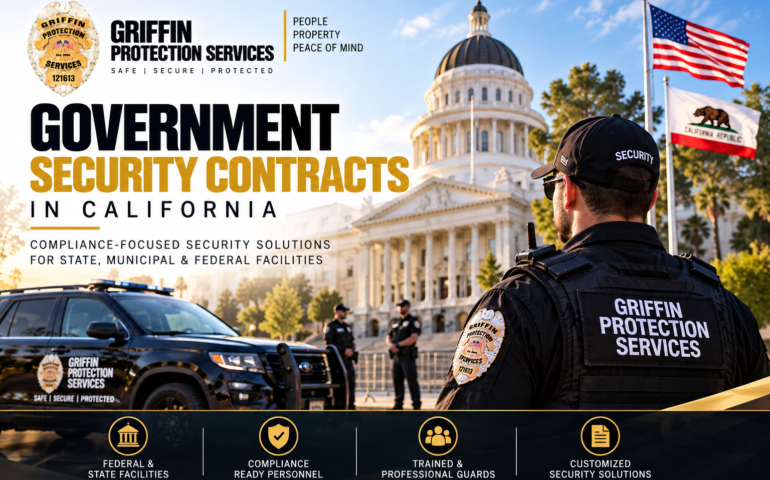
Griffin Protection Services provides unarmed, BSIS-compliant officers for government and public sector facilities across the Bay Area and Northern California. Our officers are background-screened, trained in de-escalation and supported by 24/7 management. We are locally owned and have operated since 2005 (PPO #121613).
Agencies planning a solicitation or needing interim coverage can contact us or call 408-330-6003.
The company needs a Private Patrol Operator license from BSIS, and each officer needs a valid guard registration. Individual agencies may add their own requirements.
State opportunities appear on Cal eProcure. Cities, counties, school districts and special districts post on their own procurement portals. Federal opportunities are listed on SAM.gov.
It depends on the facility. Many public sites such as libraries, offices and community centers use unarmed officers. Each solicitation states what is required.
Not always. Some agencies must select the lowest responsible bidder, and others use a best-value method that scores qualifications, approach and price together.
Terms vary, but multi-year contracts with optional extension years are common.