

If you have looked into security careers or hired an armed guard, you have probably seen the term “Level 3 security license.” It sounds like a national standard, but it isn’t. The “Level” system comes from Texas, and many other states, including California, don’t use it at all.
This guide explains what a Level 3 security license means, what it takes to earn one, and how armed security licensing works in other states. We also explain what it means for businesses hiring security in the Bay Area.
A Level 3 (Level III) security license is the Texas credential for a commissioned security officer, which in plain terms means an armed security guard. It is issued by the Private Security Program of the Texas Department of Public Safety (DPS) under Chapter 1702 of the Texas Occupations Code.
Texas organizes security training in levels:
Each level builds on the one below it. A Level III officer has completed Level II training and then added armed security training.
Requirements can change, so always confirm current rules with Texas DPS. As of 2026, the main requirements are:
Applicants must complete the Level II course, the baseline training that covers the fundamentals of security work.
The Level III course must be at least 45 hours and must be taught by a DPS-licensed Level III training school and instructor. It covers topics such as legal authority, use of force, conflict resolution, incident scene security, handcuffing, defensive tactics, and firearms.
Applicants must pass a live-fire course of fire. The firearm proficiency demonstration must be completed within 90 days of the application date.
Commissioned applicants must complete a psychological assessment (the MMPI). This confirms they are suitable to carry a firearm on duty.
Applicants submit fingerprints for state and FBI background checks. They must also be affiliated with a DPS-licensed security company through the Texas Online Private Security (TOPS) system.
Texas licenses renew every two years. Commissioned officers must complete six hours of continuing education and show firearm proficiency again.
A Level III commissioned officer may carry a firearm while on duty for a licensed security company. Typical posts include armored transport, cash handling, high-value retail, critical infrastructure, and sites with elevated threat levels.
A Level 3 license does not give police powers. Commissioned officers are private security professionals. Their authority to detain or use force is limited by state law and by their employer’s policies.
There is no single national security license in the United States. Each state sets its own rules, and credentials usually don’t transfer from one state to another.
California does not use a “Level” system. Armed security is licensed through the Bureau of Security and Investigative Services (BSIS) in two steps:
So if someone in California says a guard is “Level 3,” they usually mean a guard who holds both a guard card and a firearms permit.
Florida uses letter classes. A Class D license covers unarmed security officers and requires 40 hours of training. A Class G statewide firearm license is added for armed work and requires separate firearms training and qualification.
Some states use “armed” and “unarmed” registrations. Others use tiered certificates. A few leave licensing to cities or counties instead of the state. If you work or hire across state lines, check each state’s regulator directly.
| Texas | California | |
|---|---|---|
| Regulator | Texas DPS Private Security Program | BSIS (Dept. of Consumer Affairs) |
| Unarmed credential | Level II (non-commissioned) | BSIS Guard Card |
| Armed credential | Level III (commissioned) | Guard Card + Firearms Permit |
| Psychological screening | Yes (MMPI) | Yes (assessment before applying) |
| Uses “Level” terms | Yes | No |
If you are hiring security in San Jose, Santa Clara, or anywhere in California, “Level 3” is not the credential to ask for. Instead, confirm three things:
You can verify all three on the California Department of Consumer Affairs license search.
It’s also worth asking whether you need armed security at all. For most offices, apartment communities, hotels, construction sites, and retail centers, well-trained unarmed officers who focus on de-escalation provide strong protection with less risk and liability.
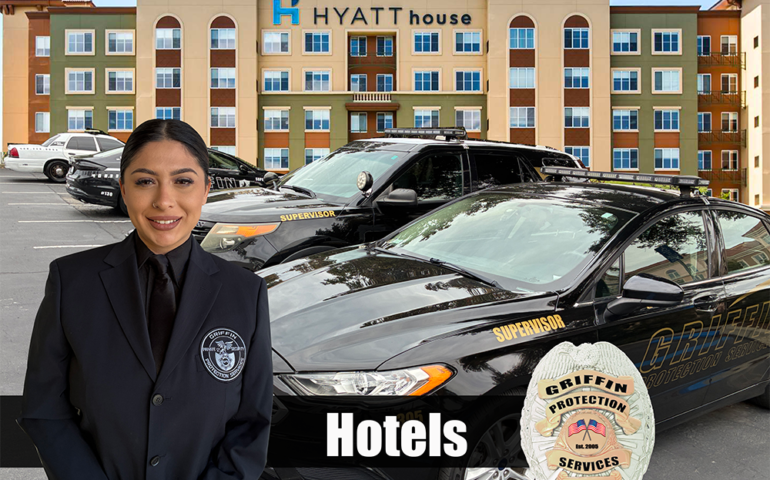
Griffin Protection Services has provided professional unarmed security guard services in the Bay Area since 2005. Every officer is BSIS-licensed, background-screened, and trained in de-escalation, access control, and incident response. Supervisors conduct regular site visits and management is available 24/7. From commercial security to apartment patrol, we match the right officers to your property’s real risks.
Is a Level 3 security license valid in California?
No. Texas licenses don’t transfer to California. Guards working in California need a BSIS guard card, plus a firearms permit for armed work.
Is Level 3 the same as an armed security license?
In Texas, yes. Level III is the commissioned (armed) security officer license.
How long does Level 3 training take?
The Texas Level III course is at least 45 hours, plus firearms qualification.
Do Level 3 security officers have police powers?
No. They are private security officers with limited authority defined by state law.
Hiring security in the Bay Area? Contact Griffin Protect or call 408-330-6003 for a free consultation.