



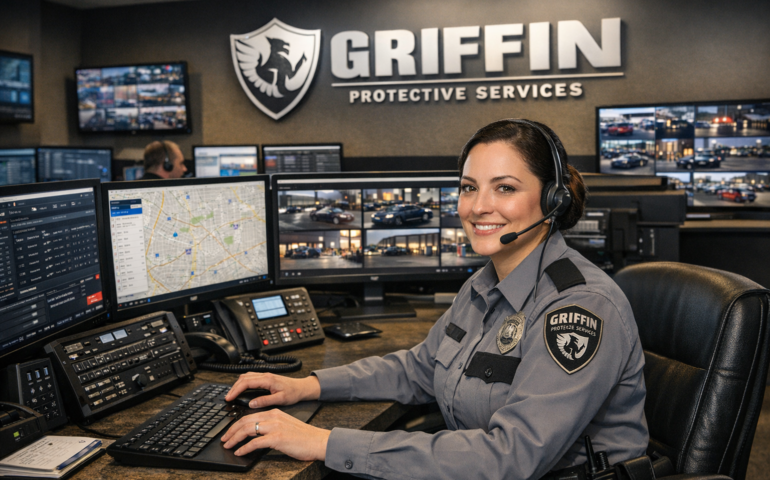
Security officers play an important role in protecting people, property, assets, and business operations. While many people associate security officers with standing at an entrance or patrolling a property, their responsibilities can extend much further. Depending on the property and security plan, officers may control access, monitor surveillance systems, conduct patrols, respond to alarms, document incidents, assist visitors, identify potential risks, and coordinate with emergency responders.
For businesses, residential communities, construction sites, offices, retail properties, healthcare facilities, schools, and other organizations, professional security officers provide an active layer of protection that complements cameras, alarms, access-control systems, and other security technology.
At Griffin Protection Services, security programs are customized around the specific risks, operating requirements, and environment of each property. Our trained security professionals serve businesses and organizations throughout the Bay Area and Northern California with solutions designed around prevention, visibility, communication, and accountability.
The primary responsibility of a security officer is to help maintain a safe and secure environment. This involves observing the property, identifying potential threats, following site-specific procedures, responding appropriately to incidents, and communicating important information to property managers or designated contacts.
A security officer’s exact duties depend on the assignment. An office security officer may focus on visitor management and access control, while a construction security officer may concentrate on preventing unauthorized entry and protecting equipment after hours. A residential security officer may monitor entrances, common areas, parking facilities, and community activity.
Common security officer duties include:
The goal is not simply to react when something goes wrong. Effective security officers work proactively to identify risks and help prevent incidents before they escalate.
One of the most important responsibilities of a security officer is helping protect people and physical assets.
Depending on the assignment, this may include protecting:
Officers maintain awareness of their surroundings and follow established procedures to identify unusual activity or potential threats.
For commercial properties, this visible security presence can also help deter theft, vandalism, trespassing, and other unwanted activity.
Access control is another major responsibility of security officers. Officers may monitor building entrances, gates, loading areas, employee entrances, or restricted locations to help ensure that only authorized individuals gain access.
Depending on the property, responsibilities can include:
Effective access control can be particularly important for corporate offices, technology facilities, warehouses, construction sites, residential communities, and other properties with controlled areas.
Patrolling is one of the most recognizable security officer responsibilities, but effective patrols involve much more than simply walking around a property.
During patrols, officers may inspect:
Officers look for signs of unauthorized access, suspicious behavior, property damage, safety concerns, unsecured doors, unusual activity, or other conditions that may require attention.
For larger properties, mobile patrol security can provide scheduled or randomized checks across multiple areas while maintaining a visible security presence.
Security officers are expected to remain alert and recognize conditions that could create a security concern.
This can include identifying:
Early identification matters because addressing a potential problem before it becomes a serious incident can help reduce disruption, property loss, and safety risks.
Professional security officers are trained to observe, assess, communicate, and follow the appropriate site procedures rather than unnecessarily escalating situations.
Security officers may also be responsible for responding when an incident occurs.
Depending on the assignment, this can include responding to:
The appropriate response depends on the circumstances and the property’s established security procedures.
Security personnel may secure the area, assess the situation, notify the appropriate parties, document what occurred, and coordinate with emergency responders or law enforcement when necessary.
A trained officer can provide an immediate on-site security presence while additional assistance is being arranged.
Documentation is a critical part of professional security operations.
Security officers may record:
Accurate reports provide property managers and business owners with a record of what happened and when it happened.
They can also help identify recurring issues and security patterns. For example, repeated incidents in the same parking area or during the same time period may indicate that additional patrols, lighting improvements, access controls, or other measures should be considered.
At Griffin Protection Services, detailed reporting is an important part of maintaining accountability and providing clients with visibility into security operations.
Every property has different security requirements. A corporate office does not have the same security needs as a construction site, hotel, apartment community, or retail center. Security officers may therefore be responsible for following and enforcing site-specific procedures related to:
Officers work according to established post orders and client-approved security procedures so that their activities support the property’s operational requirements.
Security officers are often among the first people visitors encounter when entering a property. As a result, professionalism and customer service are important parts of the job.
Depending on the assignment, officers may:
For offices, hotels, residential communities, and commercial properties, a professional security presence can provide both protection and a positive experience for occupants and visitors.
Parking lots, garages, loading zones, and property boundaries can create unique security challenges. Security officers may patrol these areas to identify:
Regular patrols can provide a visible deterrent while helping property managers identify security and maintenance concerns.
Security officers can serve an important role during emergencies. Depending on their training and the property’s procedures, officers may help manage the immediate environment during situations such as:
Their responsibilities may include directing people away from affected areas, securing access points, contacting emergency services, communicating with management, and maintaining an organized response until additional responders arrive.
Security officers do not replace police, fire, medical, or other emergency professionals. Instead, they provide an important first layer of on-site support and coordination.
Communication is an essential security responsibility.
Officers need to communicate important information clearly to:
Clear communication helps ensure that incidents are handled according to established procedures and that decision-makers receive accurate information.
For businesses with multiple locations or complex facilities, consistent communication and reporting can also improve overall security management.
A visible security officer can serve as a powerful deterrent.
Criminal activity often depends on opportunity. A professional security presence can make a property less attractive to individuals looking for easy access or vulnerable locations.
Security officers can help deter:
Deterrence is particularly valuable during evenings, overnight hours, weekends, and other periods when a property may have fewer employees or occupants.
Security officers may also interact with technology used to protect a property.
Depending on the assignment, this can include monitoring:
Technology can improve visibility, but it does not always replace the need for trained personnel.
Cameras can record activity, while alarms can identify potential events. A security officer can provide human observation, evaluate conditions on-site, document findings, and respond according to established procedures.
A professional security officer must remain alert while interacting appropriately with employees, customers, residents, visitors, contractors, and management.
Important qualities include:
Security work often requires officers to remain calm when situations become stressful or unpredictable. Professional behavior can help prevent minor situations from escalating.
Yes. Security officer responsibilities should be customized to the property’s risks and operational needs.
Office security officers may focus on visitor management, access control, lobby monitoring, employee safety, after-hours patrols, and incident reporting.
Construction security officers may monitor entrances, protect equipment and materials, conduct overnight patrols, and help prevent unauthorized access and theft.
Residential security officers may patrol common areas, monitor entrances, address security concerns, assist residents, and document incidents.
Retail security may involve monitoring parking areas, entrances, common spaces, suspicious activity, and incidents affecting customers or businesses.
Hotel security officers may monitor entrances, common areas, parking facilities, and guest-related security concerns while maintaining a professional and discreet presence.
Healthcare facilities, schools, and educational institutions may require specialized procedures for access control, visitor management, incident response, and protection of staff, students, patients, and visitors.
This is why effective security should not rely on a one-size-fits-all approach. A professional security company should first understand the property, identify relevant risks, and build an appropriate security program.
A good security officer does more than watch a property.
Effective security personnel should be able to:
Training, supervision, clear post orders, and ongoing performance management all contribute to consistent security service.
Businesses and property owners face different risks depending on their location, industry, operating hours, property layout, and assets.
Professional security officers can provide an additional layer of protection by combining human observation with established procedures and security technology.
Hiring professional security services can help organizations:
For organizations throughout the Bay Area, Griffin Protection Services provides customized security programs for commercial properties, offices, residential communities, construction sites, hotels, schools, healthcare facilities, retail properties, and other environments.
Understanding the duties and responsibilities of security officers is important when evaluating a security company. The right provider should offer more than a uniformed presence. It should provide trained personnel, clear procedures, reliable communication, appropriate supervision, and reporting that gives property managers confidence in their security program.
Griffin Protection Services provides professional security guard services throughout the Bay Area and Northern California. Our security programs can include on-site security officers, patrol services, access control, incident reporting, alarm response, and other customized security solutions based on the needs of each property.
Whether you need security for a corporate office, commercial property, residential community, construction site, retail center, or other facility, Griffin Protect can help develop a security approach based on your property’s specific requirements.
Need professional security officers for your property? Contact Griffin Protection Services to discuss your security needs and develop a customized protection plan.
The main duties of a security officer include monitoring property, controlling access, conducting patrols, identifying security risks, responding to incidents, documenting activity, enforcing site procedures, assisting visitors, and supporting emergency response.
The primary responsibility is helping maintain a safe and secure environment for people, property, and assets. The exact responsibilities depend on the security assignment and property requirements.
Security officers may respond to security incidents, alarms, safety concerns, and other emergencies according to their training and site procedures. They may also coordinate with emergency services when additional assistance is required.
Yes. Access control can be an important security officer responsibility. Officers may verify credentials, manage visitor check-in, monitor entrances, and help prevent unauthorized individuals from entering restricted areas.
Yes. Accurate incident and activity reporting is an important part of professional security operations. Reports provide property managers and security supervisors with documentation of incidents, observations, and actions taken.
A visible, professionally managed security presence can help deter theft, vandalism, trespassing, and other unwanted activity. Officers can also identify suspicious behavior and report or respond to security concerns according to established procedures.
The terms are often used interchangeably in the private security industry. The exact title and responsibilities can vary by employer, assignment, jurisdiction, and level of training. What matters most is whether the security professional is properly qualified for the duties required at the property.
Start by identifying your property’s risks, operating hours, access points, high-value assets, previous incidents, and coverage requirements. A professional security company can then conduct an assessment and recommend an appropriate combination of on-site guards, patrols, access control, alarm response, and other security measures.