



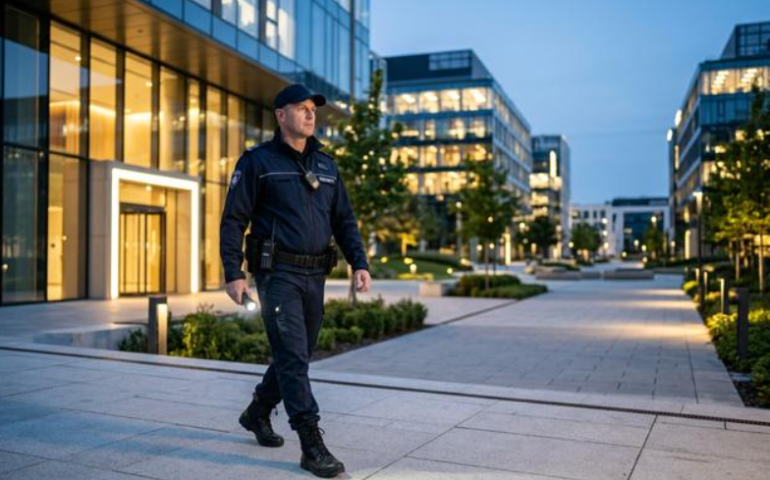
When property owners and managers start looking into security, one of the first questions is whether to hire mobile patrols or stationary guards. Both can protect people and property, but they work very differently, and the right choice depends on your site, your risks, and your budget.
This guide explains how each option works, compares their strengths and limits, and shows how to decide which one fits your property. In many cases, the best answer is a mix of both.
A mobile security patrol sends a trained officer, usually in a marked vehicle, to visit your property on a scheduled or randomized basis. During each visit, the officer checks buildings, gates, parking areas, and other vulnerable spots, looks for signs of trouble, and records what they find. They may also respond to alarms or calls between scheduled stops, and one officer can often cover several properties in a single shift.
You can learn more about how this works through our security patrol guard services.
A stationary guard, sometimes called a static or posted guard, stays at a fixed location for the whole shift. That might be a front desk, a gate, a guard booth, a loading dock, or a building entrance. Their job is to be present and attentive in one place: greeting visitors, checking credentials, monitoring cameras, controlling access, and responding to anything that happens nearby.
Strengths
Limits
Strengths
Limits
| Factor | Mobile patrol | Stationary guard |
|---|---|---|
| Coverage area | Wide, multiple areas or sites | One post or zone |
| Presence | Scheduled visits | Continuous at the post |
| Cost | Generally lower | Generally higher |
| Access control | Limited | Strong |
| Deterrence | High, thanks to unpredictability | High at the post |
| Best for | Large or multi-site properties, after-hours checks | Entrances, lobbies, gates, high-traffic areas |
There is no single winner. The better option depends on what you need to protect and how.
Choose mobile patrols if:
Examples include apartment and HOA communities, business parks, shopping centers, and parking lots and garages.
Choose stationary guards if:
Examples include corporate offices, hotels, hospitals, schools, and government facilities.
Many properties get the best results by combining both. For example:
Hybrid coverage lets you match the right tool to each risk. You can also add technology to stretch your budget further. Mobile surveillance trailers and drone monitoring extend coverage on large or open sites where one guard cannot see everything, and alarm response and access control services make sure each alert gets checked.
A professional security assessment can answer these questions with real information about your property, rather than guesses.
Mobile patrols and stationary guards each have a place. Patrols offer wide, flexible, cost-effective coverage and strong deterrence. Stationary guards offer constant presence, access control, and a welcoming face. The right choice, or the right combination, depends on your property.
Griffin Protection Services has provided licensed, unarmed patrol and guard services since 2005, with a focus on safety, de-escalation, and customized solutions. We assess each site individually and build a plan around your risks and budget, across San Jose, Santa Clara, and the wider Bay Area.