


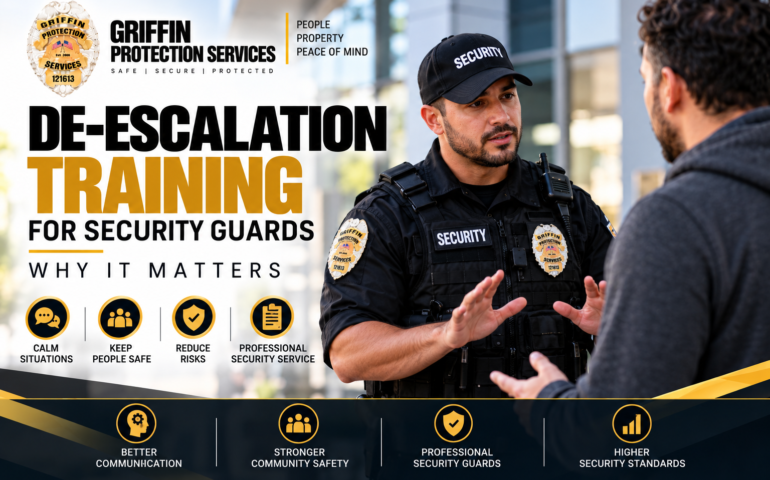
De-escalation training teaches security guards to calm a tense situation through communication, body language and patience, so that force is not needed. It matters because most incidents a guard faces are arguments, complaints and people in distress, and the way the guard responds decides whether the situation ends quietly or turns into an injury, a lawsuit or a viral video.
For a business or property manager, a guard skilled in de-escalation protects people, reputation and budget at the same time. This guide explains what the training covers and how to tell whether a security provider takes it seriously.
De-escalation is the use of verbal and non-verbal skills to lower the intensity of a conflict. The goal is voluntary cooperation. The person leaves, calms down or follows the rule because they chose to, not because they were forced.
It does not mean giving in or ignoring the rules. A well-trained officer still enforces the property’s policies. The officer simply does it in a way that gives the other person room to comply without losing face.
| Instead of | Try |
|---|---|
| “Calm down.” | “I want to help. Tell me what happened.” |
| “You have to leave now.” | “The property closes at 10. I can walk you to the exit.” |
| “That’s not my problem.” | “Let me find out who can help with that.” |
| “Because those are the rules.” | “The owner asks us to keep this area clear for safety.” |
| “If you don’t stop, I’ll call the cops.” | “I’d like to sort this out with you. If we can’t, my next step is to call the police.” |
A single video is not training. Look for a program that includes:
Many property managers assume a weapon is the strongest deterrent. For most commercial and residential properties, the daily problems are disputes and nuisance behavior, where communication solves more than force.
An unarmed officer with strong de-escalation skills lowers the chance of a serious use-of-force incident and the liability that comes with it. Our article on why local property managers prefer unarmed guards covers this in more detail.
For more on officer preparation, see how security guards are trained to handle emergency situations and our list of 12 essential skills for security guards.
Griffin Protection Services provides unarmed security officers in San Jose, Santa Clara and across the Bay Area. De-escalation is central to how we work. Our officers are trained to stay calm and professional so that peace is kept and people are treated with respect. We have served local businesses and communities since 2005 (PPO #121613).
Contact us or call 408-330-6003 for a customized security plan.
It is the use of calm communication, body language and problem-solving to reduce tension and gain cooperation without physical force.
California’s required guard training includes instruction on the appropriate use of force, which covers de-escalation. Check the BSIS website for current course requirements.
No. Some situations involve real danger. Training also teaches officers to recognize those cases, keep a safe distance and call the police.
For most properties, yes. A visible, professional officer deters problems, and communication skills resolve the majority of incidents that do occur.
Ask the provider about training and incident history, read incident reports for tone and detail, and watch how officers speak to visitors on your site.